Santa Ana has always asked a lot from a landscape. Heat settles in hard during late summer, winter rain can be sparse or wildly uneven, and water rates keep reminding homeowners that a thirsty yard is no longer a casual expense. Yet this does not mean outdoor spaces have to look bare, rocky, or apologetic. Some of the most inviting properties in Santa Ana are the ones that lean into the local climate instead of fighting it.
That shift changes everything. When a yard is designed for the place it actually occupies, not for a cooler or wetter region, it becomes easier to maintain, easier to enjoy, and usually far more distinctive. Native and climate-appropriate plants bring movement, bloom cycles, and habitat value. Thoughtful Hardscaping gives the garden structure so it still feels finished in dry months. Smart grading, mulch, and irrigation keep water where it matters. The result is not a compromise. It is often better than the old lawn-and-shrubs formula.
I have seen this firsthand on Orange County properties where homeowners began with one simple goal, cut the water bill, and ended up with a front yard that looked sharper, cleaner, and more connected to Southern California than it ever had before. Good drought resistant design is not about deprivation. It is about restraint, clarity, and choosing materials that age well under Santa Ana sun.
Why Santa Ana yards struggle with traditional landscaping
Many older yards in Santa Ana were built around expectations that no longer hold up well. Broad lawns, tropical accent plants, shallow-rooted shrubs, and narrow planting beds often require regular irrigation just to stay presentable. During a mild spring they can look acceptable. By August, the cracks start to show. Turf thins out along reflected heat zones near driveways. Flowering annuals fade fast. Plants that prefer cooler coastal conditions look stressed even when watered.
The local climate creates a few recurring pressure points. Summer heat can be intense, especially in exposed front yard landscaping with western sun. Wind events dry soils quickly. Many lots also contain compacted subsoil from construction, which means water either runs off too fast or pools in the wrong places. Add in hard surfaces that radiate heat and you get planting conditions that punish generic design.
This is why homeowners often feel frustrated after spending good money on landscapes that look polished for six months and tired for the rest of the year. The issue is rarely effort alone. It is usually plant selection, spacing, irrigation strategy, and surface materials working against the site.
Native beauty does not mean wild or messy
There is still a persistent misconception that California native planting equals a loose, chaparral look with little structure. That can be beautiful on the right property, but it is only one expression. In Santa Ana, native beauty can be highly tailored, formal, and architectural. It can frame a Spanish revival home, soften a ranch-style facade, or give a contemporary property clean, sculptural lines.
The trick is to separate plant character from plant arrangement. Native and low-water species often have naturally relaxed forms, but the composition around them can still be disciplined. Repetition creates order. Defined edges make even soft plantings look intentional. Gravel, pavers, seat walls, boulders, and decomposed granite all help hold the design together visually.
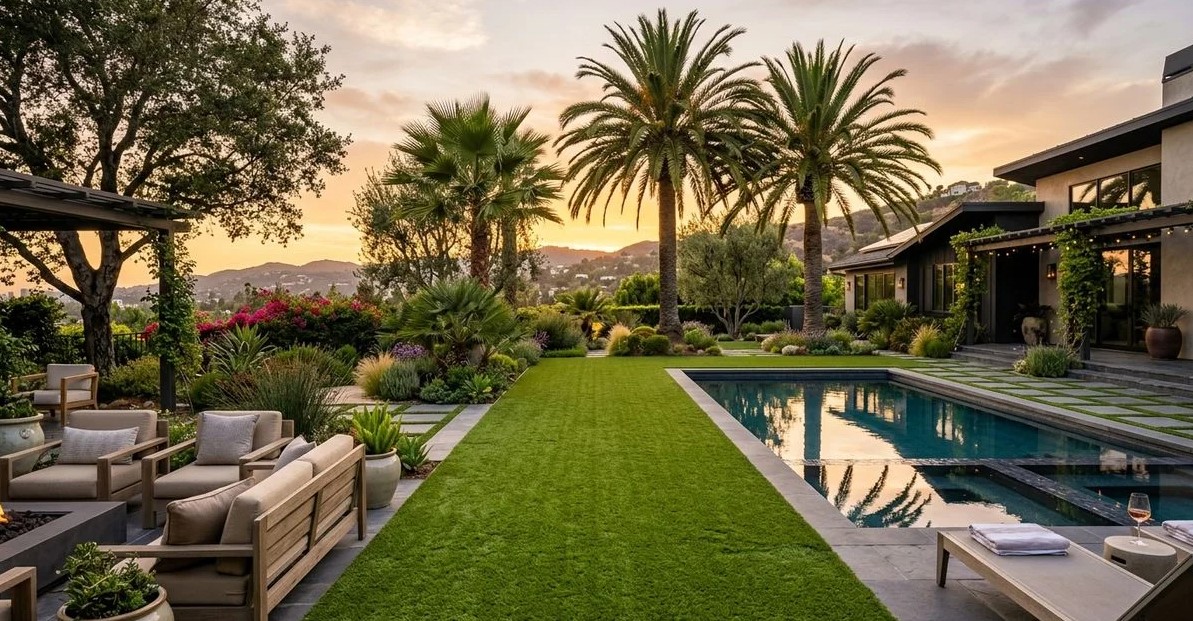
I have worked on front yards where a simple rhythm of manzanita, deer grass, and salvias gave the same sense of polish that clipped hedges once provided, only with a fraction of the water use and a lot more seasonal interest. The key was not adding more plants. It was spacing them correctly, keeping the palette tight, and giving the eye something solid to rest on.
Start with the bones, not the plants
Most successful drought resitant landscaping in Santa Ana begins with layout and drainage. Plant choices matter, but the real quality of a yard often comes from its underlying structure. If the circulation is awkward, if runoff stains the walk, or if the front yard has no focal point, even great plant material will not save it.
Hardscaping should do more than fill space. It should guide people from curb to front door, create usable outdoor moments, and control how water moves across the property. On small urban lots, this is especially important. A few feet of extra paving in the wrong place can increase heat and glare. The same square footage, handled with permeable joints or a more thoughtful orientation, can feel cooler and help infiltration.
In Santa Ana, I often advise homeowners to think of the landscape in layers. The first layer is circulation and drainage. The second is shade, screening, and privacy. The third is plant expression. That order prevents a common mistake, buying attractive plants first and then forcing them into a yard with unresolved functional problems.
Hardscaping that earns its place
The best Hardscaping in a drought-tolerant landscape is quiet, durable, and proportioned to the house. Oversized decorative elements can make a modest lot feel cramped. At the same time, a yard with too little hard surface often reads unfinished, especially in winter when many perennials are resting.
Concrete pavers with narrow gravel joints work well in Santa Ana because they provide a clean line without feeling harsh. Stabilized decomposed granite is useful for side yards, informal seating areas, and wide parkway strips where a fully planted approach would be expensive to maintain. Natural stone can be stunning, though it tends to raise the budget quickly and should be used where it has visual impact, at an entry landing, low wall cap, or short path segment.
Retaining walls deserve special care. A wall that is only there to solve grade can still become a design asset if its height is comfortable, roughly seat height where possible, and if planting softens its edges. I have seen many small front yards transformed by a low masonry wall that defines the property, catches evening light, and gives a sense of arrival without blocking visibility.
Front yard landscaping that reduces water and improves curb appeal
Front yard landscaping carries a different burden than a backyard. It has to look coherent from the street, frame the architecture, and perform with less daily attention. The old model was simple: lawn in the middle, shrubs at the foundation, tree at one corner. That arrangement is familiar, but it is often the least efficient way to design for drought.
A better approach is to divide the front yard into purposeful zones. The entry zone should be clean, legible, and easy to maintain. The house-facing zone should soften the structure without trapping moisture against walls. The public-facing zone, where the yard meets the sidewalk or curb, can carry more of the native character and seasonal movement.
This zoning helps solve another common problem, visual thinness. Many water-wise yards fail not because they use too little water, but because they use too little mass. A scattering of small plants in gravel often feels hesitant. Larger drifts of well-chosen species create confidence. Santa Ana landscapes benefit from this especially because bright light flattens weak compositions. Bold masses read better from the street and remain attractive even when not in bloom.
A front yard that performs well usually includes one or two anchor elements. That might be a California sycamore in a larger lot, a sculptural Arbutus marina, a grouping of boulders, or a band of larger grasses repeated near the walk. Once those anchors are in place, smaller flowering plants can weave through without making the design feel fussy.
Native and climate-appropriate plants that work in Santa Ana
Native plants are not all the same, and not every California native belongs in every Santa Ana yard. Some species from cooler or higher elevation regions struggle with inland heat or heavy irrigation around neighboring plants. A professional design should account for this. The safest route is to mix true California natives with Mediterranean and other climate-adapted plants that tolerate dry summers and local soils.
Here are five plants or plant groups that consistently perform well when properly placed:
- Deer grass, for soft structure, movement, and dependable form in heat California lilac, especially compact cultivars, for spring bloom and evergreen mass White sage and Cleveland sage, for fragrance, pollinator value, and a distinctly regional character Manzanita, where drainage is sharp and summer water is limited, for sculptural branching and year-round presence Red yucca, technically not a California native but an excellent low-water accent with long bloom periods
What matters as much as species choice is hydrozoning. Plants with similar water needs should share the same irrigation valve and planting area. This sounds obvious, but many problem landscapes pair a drought-tolerant shrub beside a plant that needs regular moisture, then try to split the difference with irrigation. Usually both perform poorly.
It is also worth mentioning scale. Deer grass looks fantastic when given room, but miserable when squeezed under windows. Manzanita can be stunning, but not if a sprinkler wets it all summer. Salvias can bloom for months, but only if they receive periodic cutbacks. These are not flaws. They are reminders that the right plant still has to be in the right place.
Mulch, soil, and irrigation are where savings really happen
Homeowners often focus first on what the yard will look like, which is understandable. The less glamorous parts of a drought-tolerant landscape are what determine whether it thrives. Soil preparation, mulch depth, and irrigation method have more effect on long-term performance than many people realize.
Santa Ana soils vary, but compaction is common, especially on remodeled or newly built properties. Before planting, it helps to test drainage in a few locations. If water sits too long, some species will struggle regardless of how little you water. In those cases, mounding planting areas slightly, amending selectively, or redirecting runoff can make a major difference.
Mulch does several jobs at once. It cuts evaporation, moderates soil temperature, reduces weed pressure, and gives a finished look Ridgeline patio and landscape landscaping resources to planting beds. In most drought-tolerant installations, two to three inches of organic mulch works well, kept away from the crown of the plant. Gravel mulch can work too, particularly in very modern designs, but it reflects and stores more heat. I use it more sparingly near delicate or younger plants.
Drip irrigation is usually the right baseline for planted areas, but it should not be installed and forgotten. Emitters need adjustment as plants mature. Trees need wider, deeper watering patterns than small shrubs. In the first year, many native or low-water plants require more frequent irrigation than homeowners expect while roots establish. After that, watering should taper thoughtfully. Cutting water too fast can stress even drought-tolerant plants. Keeping it too frequent trains shallow roots and defeats the purpose.
On many Santa Ana projects, the biggest operational improvement comes from replacing spray irrigation in planting beds with drip, then separating turf, if any remains, onto its own valve. That simple change often reduces waste more than swapping out a few plant species.
Custom Landscaping ideas for lots with personality
No two Santa Ana properties behave exactly the same. A shaded north-facing bungalow lot and a broad south-facing corner lot need different solutions. This is where Custom Landscaping ideas become essential. Good drought-tolerant design is not a kit. It is site-specific problem solving.
For older homes with strong architectural character, I often favor a restrained plant palette and richer materials. A Spanish-style house, for example, can carry warm gravel, clay tones, and silvery foliage beautifully. Flank the walk with repeated mounding plants and one or two upright accents, and the home feels grounded rather than crowded.
For more contemporary homes, stronger geometry usually helps. Linear paving, steel edging, and repeated structural plants can create a cleaner visual field. In these settings, the contrast between precise Hardscaping and looser flowering perennials is especially effective.
Some of the smartest Custom Landscaping ideas in Santa Ana are about using space more efficiently. A side yard can become a dry creek-style drainage feature that doubles as a visual corridor. A former lawn panel can turn into a permeable courtyard with a bench and overhead shade. A parking strip can be planted with low natives that tolerate reflected heat better than turf ever did. These are not dramatic moves, but they improve daily use and reduce maintenance at the same time.
I once worked with a homeowner near Floral Park who wanted a greener-looking front yard without reinstalling lawn. We used a broad path of decomposed granite, clustered native grasses in generous sweeps, and added a small grove effect with two well-placed trees. The finished yard read lush from the street, even though most of the planting was low-water. The lesson was simple. Fullness comes from layering and canopy, not just from irrigated groundcover.
Where homeowners often get it wrong
The failures I see most often are not dramatic. They are small judgment errors that add up over time, and they are usually avoidable.
- Using too many plant varieties, which makes the yard look busy and harder to maintain Covering the whole yard in decorative gravel with too few plants, which increases heat and feels stark Installing drought-tolerant plants but watering them on the same schedule as old foundation shrubs Ignoring mature plant size, which leads to crowding, shearing, and eventual replacement Treating the front yard only as something to look at, rather than a space with circulation, shade, and function
Another common issue is overcorrection. Some homeowners remove every soft surface in the name of water savings and end up with a yard that feels hot, echoing, and less livable. Purely mineral landscapes can work in limited areas, but most Santa Ana homes benefit from a balance of planting and hard surface. Plants cool the environment, filter views, and make a property feel inhabited.
Color, bloom, and seasonal change without constant watering
One of the pleasures of native and low-water gardens is that they teach you to appreciate a different rhythm. Instead of forcing nonstop summer color through heavy irrigation and fertilizer, you work with stronger seasonal pulses. Spring may bring salvias, ceanothus, and penstemon into bloom. Summer can shift toward grasses, red yucca, and warm foliage tones. Fall often reveals seed heads, bark, and structure. Winter exposes branch architecture and the quiet order of the layout.
That seasonal progression tends to feel more sophisticated than a landscape that chases constant bloom. It also looks more at home in Santa Ana. A drought-tolerant garden should not pretend it is in New England or the Pacific Northwest. Its beauty comes from light, texture, scent, and form as much as from flowers.
If clients want more color, I usually steer them toward strategic concentration rather than sprinkling blooms everywhere. Put stronger flowering plants where they will be seen from key viewpoints, along the entry path, outside a living room window, or near a seating area. The rest of the yard can carry calmer greens, grays, and blue foliage that hold the composition together.
Budget expectations and what is worth spending on
A water-wise renovation can range widely in cost. A modest front yard refresh with irrigation updates, selective removal, mulch, and a few new plants may be manageable for many homeowners. A full redesign with demolition, new Hardscaping, drainage work, lighting, trees, and custom planting will be a more serious investment.
Where money is best spent depends on the site, but some priorities are consistent. Drainage corrections are worth doing early because they protect everything else. Quality paving at the entry has daily value and ridgelineoutdoorliving.com landscapers in santa ana ca landscaping santa ana strong visual impact. Decent-sized trees are almost always a better investment than too many small shrubs. Irrigation should be designed carefully, not as an afterthought.
Planting size is where judgment matters. Bigger is not always better. In fact, smaller container plants often establish faster if the soil and watering are correct. But going too small can leave the yard looking incomplete for years. On client projects, I usually spend more on a few structural plants and trees, then fill in with modest perennials that will mature quickly.
A landscape that feels right five years later
The real test of drought resistant design in Santa Ana is not the install day. It is whether the yard still feels right after several hot seasons, a few pruning cycles, and changes in how the homeowner uses the space. The strongest landscapes settle in. They become easier, not harder. Plants gain character. Paths wear in nicely. Shade improves. Maintenance becomes more about editing than rescuing.
That is what native beauty offers when it is handled well. It is not just lower water use. It is a yard that belongs to its climate, supports local ecology, and gives the house a stronger sense of place. For homeowners thinking about Front yard landscaping or broader outdoor upgrades, that is the standard worth aiming for. Not a trendy xeriscape copied from another region, and not a stripped-down yard built only around utility, but a lasting Santa Ana landscape with texture, structure, and enough life in it to feel generous even in a dry year.